&geometry(132x120) "Lithgow Veterinary Hospital")


Is Your Cat Carrying Extra Weight? Here Are Signs to Look For
 "Is Your Cat Carrying Extra Weight? Here Are Signs to Look For")
Cats come in all shapes, sizes and levels of fluffiness, which can make it surprisingly difficult to tell when a few extra grams have gradually become a little too much.
Carrying excess weight is not just about how your cat looks. It can affect how comfortably they move, play, jump and groom themselves, as well as increasing their risk of several health problems.
Because changes often happen slowly, many owners do not notice their cat gaining weight straight away. A long coat, sturdy build or loose skin beneath the abdomen can make judging their shape even more difficult.
So, what should a healthy cat actually look and feel like?
How common are overweight cats?
Australian pet industry figures suggest that around one in three cats is overweight or obese.
That means seeing other cats of a similar size is not necessarily a reliable way to judge whether your own cat is at a healthy weight.
Instead, it is more useful to consider their individual frame, body shape and the amount of fat covering areas such as their ribs and waist.
If your cat is carrying excess weight, the encouraging news is that gradual and appropriately managed weight loss can help improve their movement, comfort and overall quality of life.
Recognising the problem is the first step.
Forget the idea of one 'perfect' weight
There is no single ideal weight that applies to every adult cat.
While approximately 4 kilograms is sometimes mentioned as an average, some healthy cats will naturally weigh less and others considerably more.
Breed, sex, age, muscle mass and body frame can all influence what is healthy for an individual cat.
The number on the scales is only part of the picture.
The scales are useful, especially when you track changes over time, but vets also look at your cat's body shape and the amount of fat covering particular areas of the body. This assessment is known as a Body Condition Score.
The important question is not:
“Does my cat weigh more than someone else's cat?”
Instead, ask:
“Is my cat carrying an appropriate amount of body fat for their own frame?”
Give your cat these three simple checks
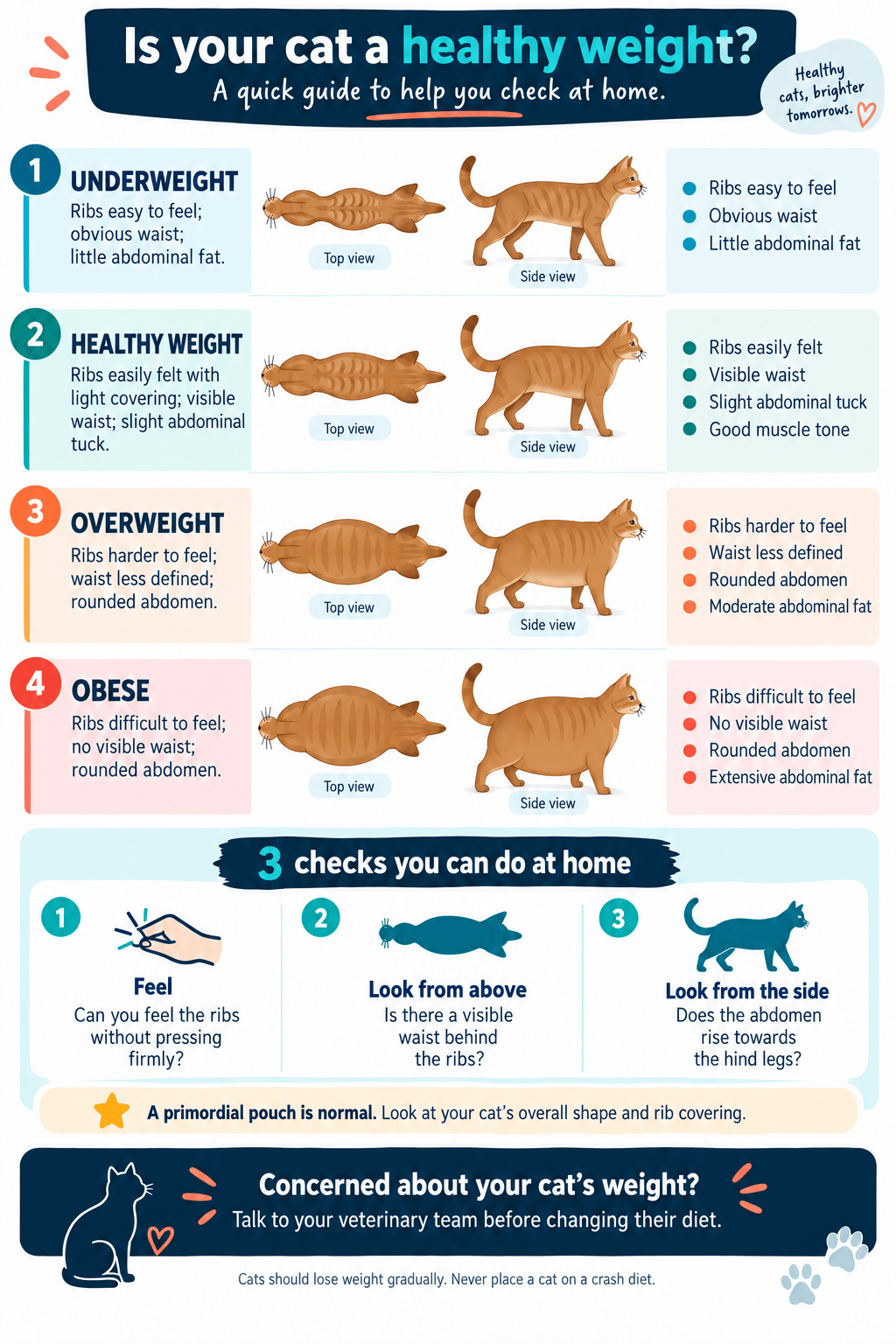
For fluffy cats in particular, using your hands can often be more helpful than simply looking at them.
1. Can you feel their ribs?
Place your hands gently over both sides of your cat's chest.
You should be able to feel the ribs without needing to press firmly, but they should have a light covering over them rather than feeling sharply prominent.
If finding the ribs requires pressing through a noticeable layer of padding, your cat may be overweight.
If the ribs are very prominent or clearly visible, they may instead be underweight.
2. Can you see a waist?
Look down at your cat while they are standing naturally.
A cat at a healthy body condition should generally narrow slightly behind the ribs before becoming wider again around the hips.
Cats carrying too much weight often lose this visible waist and can begin to look rounded or rectangular from above.
3. Does their tummy tuck upwards?
Now look at your cat from the side.
Ideally, the abdomen should rise slightly as it moves towards the hind legs.
Don't mistake the primordial pouch for excess weight
The primordial pouch is a normal area of loose skin and tissue beneath a cat's abdomen. It often swings when they walk and can be obvious even in cats at a perfectly healthy weight.
Look at your cat's overall body shape and how easily you can feel their ribs rather than using the pouch alone to judge their weight.
Has anything else changed?
Sometimes weight gain becomes more noticeable through changes in your cat's behaviour rather than their appearance.
You may find that your cat:
Pauses or hesitates before jumping
No longer reaches the same high spots
Uses furniture as several smaller 'steps' instead of making one jump
Plays less than they once did
Spends more time sleeping
Becomes tired more quickly
Struggles to groom their back or hindquarters
Develops matted, greasy or flaky fur
Seems reluctant to climb stairs
Has outgrown a previously comfortable collar or harness
Weight is not always the cause.
Arthritis, pain and other health conditions can cause similar changes in your cat's movement, activity and grooming.
If your cat is moving differently, playing less or struggling to keep themselves groomed, make an appointment with us today. We can assess their overall health and help determine whether excess weight, discomfort or another condition may be playing a role.
How can extra weight affect my cat's health?
Excess body fat can have consequences throughout the body.
Extra weight places additional pressure on the joints, which can make running, jumping and climbing less comfortable.
This can also become a difficult cycle. If moving hurts, a cat may become less active. Reduced activity can then make maintaining a healthy weight even harder.
Overweight and obese cats may face a greater risk of:
Diabetes mellitus
Arthritis and mobility problems
Urinary tract problems
Difficulty grooming
Breathing and cardiovascular problems
Complications associated with anaesthesia and surgery
- Poorer quality of life
A relatively small change can represent a significant percentage of a cat's total body weight.
400 grams can be more significant than it sounds.
For a cat that originally weighed 4 kilograms, gaining 400 grams represents a 10 per cent increase in body weight. That would be equivalent to a 70-kilogram person gaining approximately 7 kilograms.
A healthy weight is about more than a number.
Maintaining a healthy weight is about helping your cat stay comfortable and able to enjoy normal feline activities, not simply achieving a particular number on the scales.
What causes weight gain in cats?
For most cats, weight gradually increases when they consume slightly more energy than they use.
Common reasons include:
- Constantly topping up the food bowl
- Leaving unlimited dry food available
- Offering portions larger than your cat needs
- Treats or table food adding extra calories
- Different members of the household each giving treats
- Living mostly indoors with limited activity
- Boredom leading to more food-seeking behaviour
- Changes in metabolism and energy needs following desexing
- Becoming less active with age
- Arthritis or pain reducing movement
- Stealing food from another pet
Feeding guides are only a starting point.
Food packaging can help provide an initial feeding guide, but your cat may need more or less than the amount printed on the pack. Their nutritional needs vary with their age, lifestyle, body condition, activity and overall health.
Small extras can add up over time.
When portions are small to begin with, even a little extra food can make a significant difference over time.
How can I help my overweight cat?
Before making major changes, it is a good idea to establish where your cat is starting from.
Start with a health and weight check
At Lithgow Veterinary Hospital, we can check your cat's current weight, assess their Body Condition Score and consider their diet, activity and overall health.
We can also check whether pain or another medical issue may be making it harder for your cat to stay active.
A healthy weight plan might include:
Accurately measuring their daily food
Offering smaller meals throughout the day
Reducing unrestricted access to food
Including treats as part of the total daily allowance
Choosing a diet suited to their nutritional and weight-management needs
Feeding pets separately
Introducing more play and enrichment
Regularly monitoring their weight and body condition
Weight loss should always be gradual.
Never try to make an overweight cat lose weight quickly by drastically restricting their food.
Severe calorie restriction or a sudden period without food can put cats, particularly overweight cats, at risk of a serious liver condition called hepatic lipidosis.
If your cat suddenly stops eating, please contact Lithgow Veterinary Hospital promptly.
Get them moving in ways cats actually enjoy
You do not necessarily need a formal 'exercise program' to help your cat become more active.
Cats naturally enjoy behaviours such as chasing, climbing, stalking and searching.
A few short sessions with a wand toy, rolling ball or toy mouse throughout the day can help encourage movement.
You could also use puzzle feeders or hide small portions of their daily food around the house to make them work a little harder for their meals.
Indoor cats may benefit from scratching towers, cat trees and safe elevated areas where they can climb and perch.
If your cat is older, very overweight or already showing signs of reduced mobility, keep activities gentle to begin with.
Pain or arthritis should always be considered if your cat suddenly becomes reluctant to jump, climb or play.
Keep track of changes
Regular weight checks are useful because small changes can be difficult to see at home.
For cats already at a healthy weight, checking every few months can help you notice trends before they become significant.
Cats actively trying to lose weight will generally need more frequent monitoring.
Track changes over time
Lithgow Veterinary Hospital can help you decide on an appropriate target and weighing schedule for your cat, taking into account their starting condition, age, lifestyle and overall health.
Keeping a record also lets you see their progress over time rather than relying on how different they look from one day to the next.
Not sure whether your cat is simply fluffy?
You are definitely not alone.
A thick coat, primordial pouch and gradual changes over time can make judging a cat's weight much harder than it sounds.
A healthy weight is about more than the number on the scales.
A proper assessment considers your cat's body condition, muscle mass, nutritional needs, mobility and overall health.
If you have been wondering whether your cat could benefit from losing a little weight, book a wellness check with our team at Lithgow Veterinary Hospital.
We can help you understand your cat's current condition and talk through practical changes suited to their individual needs.
Helping your cat maintain a healthy weight now can support their comfort, mobility and quality of life throughout the years ahead.
| Tags:CatClient InformationHealth Advice |